
Beyond 'Think Step by Step': How to Build a Reasoning Scaffold That Forces AI to Actually Think
"Think step by step" used to be a genuine insight. It isn't anymore — at least not as a complete prompting strategy.
The phrase triggers a reasoning mode, yes. But it gives the model zero constraints on how to reason. The model fills in the blanks the only way it knows: by pattern-matching to whatever sequential reasoning looks like in its training data. For simple arithmetic or well-structured problems, that's often enough. For ambiguous analysis, complex diagnosis, or high-stakes multi-variable decisions? The model steps its way to a confidently stated wrong answer.
There's a sharper version of this technique. It's called a Reasoning Scaffold, and the difference isn't semantic.
What "Think Step by Step" Actually Does (And Where It Breaks)
To understand why generic CoT fails on hard problems, you need a clear mental model of what it does mechanically.
When you say "think step by step," you shift the model's output distribution toward sequential, explanatory content. Each generated token is influenced by everything before it — so when the model produces an intermediate reasoning step, that step becomes part of the context that shapes the next one. The model builds on its own outputs. That's the mechanism.
The failure mode appears when the structure of that reasoning is unconstrained. Without explicit guidance on what kind of thinking to do at each stage, the model defaults to the path of least statistical resistance. It produces reasoning that looks systematic — numbered steps, logical connectives, an air of rigor — but follows the narrative shape of whatever similar-looking text was most common in training data. On novel or ambiguous problems, that path almost never matches the actual cognitive structure the problem requires.
The result: fluent, confident, structurally valid reasoning that reaches the wrong answer. The chain-of-thought didn't fail. The scaffold wasn't there.
Generic CoT vs. Reasoning Scaffold: The Structural Difference
| Dimension | Generic "Think Step by Step" | Reasoning Scaffold (Observe → Hypothesize → Test → Conclude) |
|---|---|---|
| Cognitive path | Free-form; follows the narrative inertia of training data | Constrained; enforces empirical inquiry logic at each stage |
| Solution space | Wide — wrong intermediate steps easily propagate forward | Narrow — each stage prunes the space for the next |
| Auditability | Difficult — observations, opinions, and conclusions are intermixed | High — each stage is structurally isolated and independently inspectable |
| Best fit | Simple arithmetic, linear logic with a fixed schema | Ambiguous analysis, multi-variable diagnosis, high-stakes decisions |
The Reasoning Scaffold: Forcing a Specific Cognitive Path
A Reasoning Scaffold doesn't just ask for sequential output. It prescribes the type of cognition required at each step. The model isn't generating reasoning in general — it's executing a defined procedure.
The four-stage scaffold that maps to most analytical and diagnostic tasks:
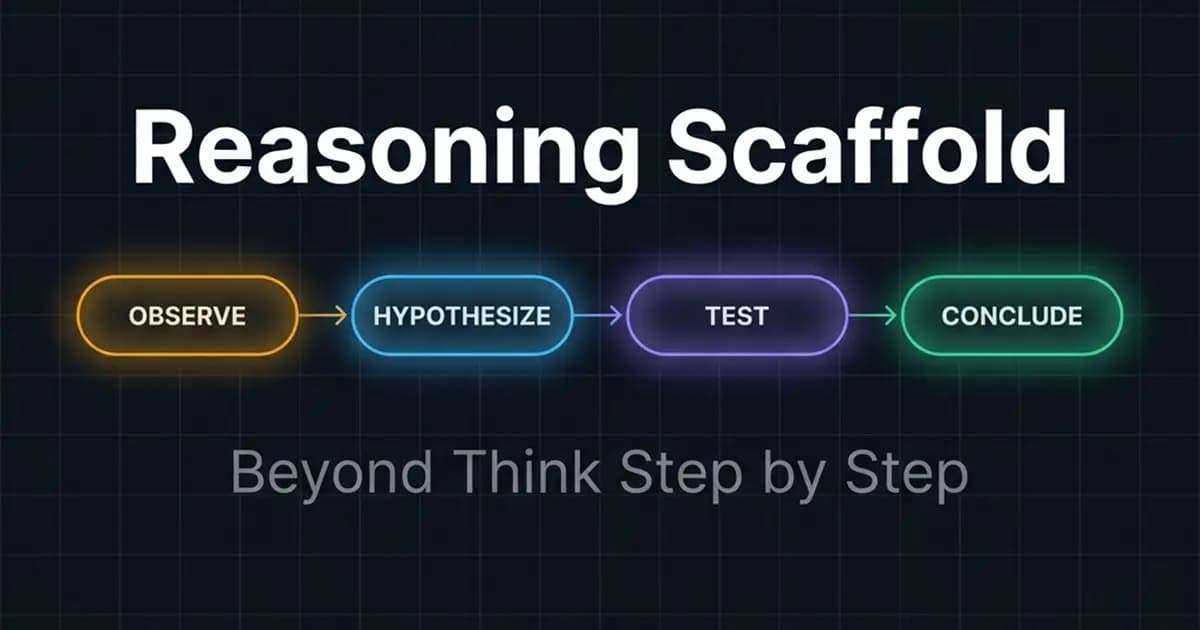
Observe → Hypothesize → Test → Conclude
This mirrors the structure of empirical inquiry, not coincidentally. It was formalized in the scientific method because it reflects how rational investigation actually works when the answer isn't obvious. The same structure imported into a prompt forces the model to treat hard problems with the same discipline.
Here's what each stage does mechanically:
Observe: The model must identify and explicitly state what it actually knows from the input — facts, data, stated constraints — without interpretation. This step prevents the model from jumping to pattern-matched conclusions before it has enumerated the actual problem space.
Hypothesize: Given what's observed, the model generates candidate explanations or solutions — not one, at least two. This matters because a single hypothesis is just an early conclusion dressed up as a draft. Multiple hypotheses force the model to map the problem space before committing.
Test: For each hypothesis, the model must reason about the evidence for and against it, or simulate what would happen if the hypothesis were true. This is where the cognitive work happens. Without this stage, hypotheses go unexamined — the model just picks whichever one it generated first.
Conclude: Only after the test stage does the model synthesize a final answer — explicitly derived from the testing phase, not from a pattern match to the original problem.
The token-level effect of this structure is significant. Each stage constrains the generation space for the next. A well-executed Observe stage rules out irrelevant solution paths. A concrete Hypothesize stage gives the Test stage something specific to evaluate. By the time the model reaches Conclude, it has substantially more context — all of it directly relevant — than any "step by step" trace would have produced.
Research on Structured Chain-of-Thought prompting — specifically the paper Structured Chain-of-Thought Prompting for Code Generation (Li et al., 2023) — confirmed the core insight: when models are given structure that maps to the logical architecture of a problem domain, performance improvements over generic CoT are substantial and consistent. The mechanism isn't mystical — constrained generation searches a smaller, more relevant region of the output distribution.
The Template
Here's the exact prompt structure. Copy it as a base, then adapt the domain-specific framing for your use case:
You are [role relevant to the problem].

Problem: [State the problem clearly and completely.]

Reason through this problem using the four-stage structure below.
Complete each stage fully before moving to the next. Do not compress or merge stages.

<observe>
List the specific facts, data points, and constraints present in the problem.
Do not interpret yet — only enumerate what is explicitly stated or directly implied.
</observe>

<hypothesize>
Based on your observations, generate at least two meaningfully different candidate
explanations or solutions. State each as a clear, testable proposition.
</hypothesize>

<test>
For each hypothesis: state (a) what data or evidence would support it,
(b) what data or evidence would contradict it, and (c) which is more consistent
with the observations. Where possible, specify a concrete verification action
or data query that would confirm or rule out each hypothesis.
</test>

<conclude>
Based solely on the test stage above, state your final answer.
Do not introduce new information here — only synthesize from what the test established.
</conclude>
The upgrade from bold headings (**OBSERVE:**) to XML tags is significant beyond aesthetics. Modern large models have a sharper boundary-perception for XML tags — the open/close tag structure signals a hard delimiter that plain markdown bold text does not. On smaller or quantized models, this difference in stage-separation is often the deciding factor between a compressed, merged output and a properly sequenced one. For teams parsing scaffold output in a pipeline, XML tags also make extraction trivial: a single regex or ElementTree parse extracts each stage without string-hacking the prose.
The instruction to produce at least two hypotheses is load-bearing. Remove it and the model will default to generating one — which is functionally identical to asking for a conclusion before testing.
Author's Comment: I add an explicit constraint at the Conclude stage: "Do not introduce new information here — only synthesize from what the Testing stage established." Without this, capable models will sometimes add hedging context or qualifications in the conclusion that didn't appear in the testing phase. They're not wrong exactly, but they've skipped the audit trail. The conclusion should be derivable from the test output alone.
A Worked Example: Supply Chain Bottleneck
This is the scenario from the original snippet, translated into a full scaffold prompt.
The Problem:
A consumer electronics manufacturer is seeing 34% of orders fail to ship on time in Q2. On-time delivery was 91% in Q1. The changes since Q1: a new warehouse management system was deployed in April, a key component supplier switched to a new logistics partner, and the product mix shifted toward a higher proportion of large-format items that require different packing configurations.
The Scaffold in Action:
You are a supply chain analyst specializing in logistics and operations.

Problem: A consumer electronics manufacturer is seeing 34% of orders fail to ship on time in Q2, down from 91% on-time delivery in Q1. Three changes occurred: new WMS deployment in April, supplier's logistics partner change, and product mix shift toward large-format items.

Reason through this using the following structure:

OBSERVE: [...]
HYPOTHESIZE: [...]
TEST: [...]
CONCLUDE: [...]
What a well-executed scaffold produces (in a plain-text interaction; in a Pydantic pipeline this maps directly to the ReasoningScaffold schema fields):
<observe>
On-time rate dropped from 91% to 66% — a 25-point degradation — coinciding with three
simultaneous system/process changes. The WMS deployment and logistics partner switch both
have direct impact on shipping execution. The product mix shift adds a packing complexity
variable.
</observe>

<hypothesize>
H1: The WMS deployment introduced process failures (incorrect pick lists, improper carrier
integration, staging errors) that account for most of the degradation.
H2: The new supplier logistics partner has longer lead times or less reliable transit,
causing upstream delays that cascade into shipping failures regardless of warehouse performance.
H3: The large-format product shift exposed a packing capacity constraint (labor, materials,
dock space) that the warehouse can't handle at scale.
</hypothesize>

<test>
- **H1 — Data assertion:** *"Query the WMS event log: of all delayed shipments in April–May, what percentage were processed through the new WMS vs. the legacy system? If WMS-processed orders show a late rate ≥ 3× that of legacy-processed orders, H1 is the primary driver."* Supporting signal: WMS errors concentrate in the first 4–6 weeks post-deployment and typically manifest as uniform failure across SKUs. Contradicting signal: if failure rate varies significantly by product type, the WMS is not the sole cause.
- **H2 — Data assertion:** *"Isolate orders containing SKUs sourced from the affected supplier. Compare their on-time rate against orders with zero supplier-switched components. If the affected-supplier cohort's late rate exceeds the unaffected cohort's by ≥ 20pp, H2 is active."* Supporting signal: delays cluster at the inbound receiving stage, not at outbound shipping. Contradicting signal: if inbound lead times are unchanged but outbound staging is the bottleneck, supplier logistics is not the root cause.
- **H3 — Data assertion:** *"Segment all delayed orders by SKU dimension class (standard vs. large-format). If the large-format late rate exceeds standard-format by ≥ 2.5×, packing capacity is a confirmed constraint."* Supporting signal: standard-size product on-time rates remain near Q1 levels (≥ 88%). Contradicting signal: if both size classes show equivalent degradation, packing capacity is not the differentiating factor.
</test>

<conclude>
Without internal data, H1 and H3 are most consistent with the timeline (immediate
degradation post-April changes) and scope (34% failure rate indicates a systemic issue,
not a single-supplier event). The assertions above are ordered by investigative priority:
run the H3 segmentation first — it requires only an order-export by SKU dimension and is
resolvable in under an hour. H1 requires WMS log access and will take longer. H2 can be
ruled in or out based on inbound receiving timestamps alone.
</conclude>
That's a structurally sound diagnostic output. Compare it to what "think through this step by step" typically produces: a prose paragraph that identifies the three changes, notes they "could all be contributing factors," and suggests "investigating each area." The scaffold version forces the model to produce testable predictions that narrow the investigation before recommending action.
When the Scaffold Is Overkill
The Reasoning Scaffold is overhead. It produces longer outputs, takes more tokens, and adds structure that's unnecessary for simple tasks.
Use it when:
- The problem has multiple plausible explanations and the wrong one is expensive
- The task requires the model to remain neutral between competing hypotheses before committing
- You need an auditable reasoning trace — one where you can inspect exactly what evidence the model used to reach its conclusion
- The stakes are high enough that a wrong answer has real consequences
Skip it when:
- The task is single-step (classification, translation, formatting, summarization)
- The answer has a straightforward verification path — you're not diagnosing, you're computing
- You need a fast draft and will apply your own judgment to the output
This connects to a broader principle about matching your prompting technique to the cognitive structure of the task. The Recursive Reflection framework approaches the same quality problem from a different angle — using a structured critique loop after generation rather than a constrained reasoning procedure during it. Both work; the choice depends on whether the quality problem is in the reasoning phase or the drafting phase.
Combining the Scaffold with Prompt Chaining
One underutilized pattern: using the Reasoning Scaffold as a stage within a prompt chain rather than as a complete standalone prompt.
In this setup, the scaffold runs as a dedicated analysis step that produces structured intermediate output (the four-stage reasoning trace), and that output feeds into a subsequent generation step that produces the final deliverable — a report, a recommendation, an action plan.
The benefit: the reasoning stays decoupled from the formatting and presentation concerns. The analysis step can focus entirely on getting the logic right. The generation step receives a structured evidence base to work from, rather than being asked to reason and write simultaneously.
If you're building workflows like this, the structural principles in Prompt Chaining: How to Build AI Workflows apply directly — specifically the discipline of defining explicit output schemas at handoff points. When your scaffold output feeds another prompt, the four-stage structure becomes that schema. The downstream prompt knows exactly where to find the relevant information.
Production Implementation: Structured Output with Pydantic
Readers who reached this section are likely already asking the obvious follow-up: how do I parse this reliably in code, rather than regex-hacking XML out of a string?
The answer is to bind the scaffold structure to a Pydantic schema and use your model provider's native structured output mode (OpenAI's response_format, Anthropic's tool-use JSON mode, or the instructor library as a provider-agnostic wrapper). This locks the output shape at the API level — the model cannot produce a malformed response that breaks your pipeline.
from pydantic import BaseModel, Field
from typing import List
import instructor
from openai import OpenAI

# --- Schema definition ---
class Hypothesis(BaseModel):
    id: str = Field(description="Short identifier, e.g. H1, H2")
    statement: str = Field(description="Clear, testable proposition")

class HypothesisTest(BaseModel):
    hypothesis_id: str
    supporting_evidence: str = Field(description="Data or signals that would confirm this hypothesis")
    contradicting_evidence: str = Field(description="Data or signals that would rule it out")
    verification_query: str = Field(description="Concrete data query or action to confirm/refute")
    assessment: str = Field(description="Which evidence is more consistent with observations")

class ReasoningScaffold(BaseModel):
    observe: str = Field(description="Enumerated facts and constraints — no interpretation")
    hypotheses: List[Hypothesis] = Field(min_length=2)
    tests: List[HypothesisTest]
    conclude: str = Field(description="Final answer derived only from the test stage")

# --- Instrumented client ---
client = instructor.from_openai(OpenAI())

def run_scaffold(problem: str, role: str) -> ReasoningScaffold:
    return client.chat.completions.create(
        model="gpt-4o",
        response_model=ReasoningScaffold,
        messages=[
            {"role": "system", "content": f"You are {role}."},
            {
                "role": "user",
                "content": (
                    f"Problem: {problem}\n\n"
                    "Reason through this using the Observe → Hypothesize → Test → Conclude "
                    "scaffold. Generate at least two meaningfully distinct hypotheses. "
                    "For each test, provide a specific verification query or data assertion. "
                    "The conclusion must be derived solely from the test stage."
                )
            }
        ]
    )

# --- Usage ---
result = run_scaffold(
    problem="On-time delivery dropped from 91% to 66% in Q2 after three simultaneous changes: WMS deployment, supplier logistics switch, and product mix shift toward large-format SKUs.",
    role="a supply chain analyst specializing in logistics and operations"
)

print(result.observe)
for test in result.tests:
    print(f"[{test.hypothesis_id}] Verify: {test.verification_query}")
print(result.conclude)
This schema does three things that a plain-text scaffold cannot: it enforces min_length=2 on hypotheses (no single-hypothesis shortcuts), it requires verification_query to be a non-empty field on every test (no vague "check this" responses), and it makes the conclude stage a separate typed field that the model cannot contaminate with reasoning from outside the test stage. The output is a Python object your code can immediately act on — log to a database, route to the next chain step, or render into a report — without any string parsing.
Author's Comment: In my own pipelines, I store
ReasoningScaffoldobjects directly in a structured trace log. When a downstream decision turns out to be wrong, I can replay the exact scaffold that produced it — observations, hypotheses, tests, conclusion — and identify exactly which stage introduced the error. This is the audit trail that makes AI-assisted decisions defensible in a professional context.
Practical Pitfall Avoidance Guide
Pitfall 1 — The model compresses stages together. On complex problems, the model sometimes runs OBSERVE and HYPOTHESIZE in one block, or merges TEST and CONCLUDE. This defeats the structural separation that makes the scaffold work. Fix: add an explicit instruction — "Complete each stage fully before proceeding to the next. Do not compress stages."
Pitfall 2 — Single hypothesis despite the instruction. Even with "at least two hypotheses" specified, some models will generate one clear hypothesis and a weak alternative that isn't genuinely distinct. Fix: "Generate at least two meaningfully different hypotheses — not variations on the same explanation."
Pitfall 3 — The TEST stage becomes a restatement of HYPOTHESIZE. The model says "H1 is plausible because..." and restates the hypothesis without actually evaluating it against evidence. Fix: "For each hypothesis, explicitly state what evidence would support it and what evidence would contradict it. Only then assess which is more consistent with the observations."
Pitfall 4 — Using the scaffold on data-sparse problems. If the input lacks concrete facts, the OBSERVE stage will pull in background knowledge as though it were observed data — and the chain contaminates from there. The scaffold works on problems with enough defined constraints. On open-ended, opinion-style tasks, it produces the appearance of rigor without the substance.
Building and Testing Scaffolds Without Token Waste
One practical consideration before committing to a Reasoning Scaffold in production: the output is substantially longer than a standard CoT trace. A scaffold-enabled analysis on a complex problem can run 600–900 tokens of output, compared to a 150-token direct answer or a 300-token standard CoT trace.
At low volume that's inconsequential. At scale — if you're running this across hundreds of documents or API calls per day — the token overhead becomes a real budget line. The cost differential between a direct-answer run and a scaffold-enabled run on GPT-4o vs. a more economical model can be significant.
When designing and iterating on a scaffold prompt before deploying it to an API pipeline, the Prompt Scaffold tool is useful for this phase: it lets you build and assemble the Role, Task, Context, and Format fields in a structured in-browser editor with a live token estimate, so you can see how your scaffold prompt grows before you run it against a paid API. The four fields map cleanly to the components a well-formed scaffold prompt needs — and the token counter gives you a working cost estimate without burning API budget on drafts.
Once the scaffold structure is locked, then run it through your API of choice and validate accuracy on representative test cases. In production, a practical cost pattern is to run the reasoning trace on a capable model (GPT-4o, Claude 3.5 Sonnet) and store the structured ReasoningScaffold output asynchronously, then pass only the conclude field to a lighter model (GPT-4o mini, Haiku) for any downstream formatting or report generation. The logic runs where it needs full capability; the formatting runs where it's cheapest.
The Underlying Principle
The Reasoning Scaffold is a specific application of a general principle: the model can only work with what's in the context window, and the structure of what's there determines the quality of what comes next.
"Think step by step" populates the context with some reasoning. A Reasoning Scaffold populates it with structured reasoning — reasoning that maps to the logical requirements of the problem. That mapping is what produces the quality difference on hard analytical tasks.
The technique isn't magic. It's a constraint system. And on any non-trivial problem where the answer isn't immediately deducible, constraint beats freedom every time.
Related reading:
- Recursive Reflection: The Draft → Critique → Rewrite Loop — A complementary quality framework for when the problem is in the drafting phase, not the reasoning phase
- Prompt Chaining: How to Build AI Workflows — How to use the Reasoning Scaffold as a dedicated analysis stage inside a multi-step prompt chain
- Chain-of-Thought Prompting Explained — The foundational mechanics of CoT that the Reasoning Scaffold builds on
- Prompt Scaffold — Structured in-browser prompt builder for assembling and testing scaffold prompts with live token estimates before API deployment